Skip to content

Blog archive

Showing 529–540 of 540 articles, newest first.

Comparison

Single-Agent or Multi-Agent? How to Choose the Right Agent Architecture for the Right Problem

As AI agent systems become more common, one of the most important architectural questions is whether to use a single powerful agent or distribute tasks across multiple specialized agents. Many teams assume multi-agent systems are automatically more advanced, leading to unnecessary complexity. Others force truly separable workflows into a single agent and lose quality, control, and scalability. This guide compares single-agent and multi-agent architectures across technical, operational, cost, security, observability, coordination, and governance dimensions, and explains how to choose the right architecture for the right enterprise problem.

25 minAgents
Guide

Tool Calling, Planning, and Memory: How to Build a Reliable AI Agent Architecture

Building a reliable AI agent is not just about giving a large language model access to tools. Production-grade quality depends on how the agent chooses tools, plans multi-step tasks, manages memory, decides when to involve humans, and how the entire execution flow is observed and governed. This guide explains tool calling, planning, and memory from an enterprise systems perspective, and presents a practical architecture for reliable agentic AI with state management, human-in-the-loop design, observability, security, and governance.

25 minAgents
Deep Dive

Why RAG Projects Fail: Critical Mistakes in Data Preparation, Evaluation, and Prompt Design

RAG projects often look impressive in demos but begin to fail in production due to quality, trust, and sustainability problems. In most cases, the root cause is not the model itself, but structural weaknesses in data preparation, retrieval design, evaluation discipline, and prompt behavior. Dirty or outdated documents, weak chunking strategies, poor metadata, missing retrieval evaluation, and underdesigned prompts can push even strong LLMs toward low-trust answers. This guide explains why RAG projects fail and provides a production-oriented framework for building more reliable systems across data preparation, evaluation, and prompt design.

24 minRAG
Guide

How to Improve RAG Quality with Hybrid Search, Metadata Filtering, and Query Rewriting

In many RAG systems, quality problems come not from the language model itself but from retrieval. Wrong chunks, outdated documents, missed exact-match queries, or poorly interpreted user intent can push even strong models toward weak or misleading answers. This guide explains three of the most effective ways to improve RAG quality in production: hybrid search, metadata filtering, and query rewriting. It covers the technical rationale, enterprise use cases, common mistakes, and practical design strategies for building more reliable retrieval pipelines.

22 minRAG
Deep Dive

Building a Document-Based AI Assistant: Secure RAG with PDFs, Wikis, SOPs, and Policy Data

Document-based AI assistants are among the most powerful enterprise AI applications for enabling fast, grounded, and controlled access to internal knowledge through natural language. But building a secure production-grade RAG system is far more than indexing PDFs and connecting them to an LLM. Source ingestion, parsing, version control, access permissions, chunking, retrieval, citation accuracy, user roles, observability, and governance all need to be designed together. This guide explains how to build a document-based AI assistant end to end using PDFs, wikis, SOPs, and policy content within a secure enterprise RAG architecture.

24 minRAG
Comparison

RAG or Fine-Tuning? Which Approach Is Better for Which Scenario?

One of the most important strategic questions in enterprise AI is whether a problem should be solved with RAG or with fine-tuning. Many teams treat these approaches as direct alternatives, but in reality they solve different classes of problems. RAG strengthens access to current and source-grounded knowledge, while fine-tuning shapes model behavior and task adaptation. This guide compares RAG and fine-tuning across technical, operational, cost, governance, and production-readiness dimensions, and explains when each approach is the right choice—and when a hybrid architecture makes more sense.

23 minLLMs
Guide

How to Design an Enterprise RAG System: A Guide to Chunking, Embeddings, Retrieval, and Reranking

Enterprise RAG systems are one of the most powerful ways to connect large language models with internal company knowledge in a reliable, auditable, and source-grounded way. But building a production-grade RAG architecture is far more than uploading documents into a vector database. Source selection, parsing, chunking strategy, embeddings, metadata design, hybrid retrieval, reranking, prompt assembly, evaluation, observability, security, and governance all need to work together. This guide explains how to design an enterprise RAG system end to end and what it really takes to make chunking, retrieval, and reranking decisions that improve quality in production.

22 minRAG
Comparison

Comparing the AI Engineering Stack: Orchestration, Deployment, Observability, and Evaluation Layers

Production-grade AI systems require far more than choosing a model or framework. Real success depends on how well orchestration, deployment, observability, evaluation, security, and governance layers work together. This guide compares the core layers of the AI engineering stack, explains what each layer is responsible for, where teams make the wrong architectural decisions, and how organizations can build a more reliable and scalable AI operating model.

21 minLLMOps
Guide

Model Monitoring, Drift, and Feedback Loop Design: How AI Systems Survive in Production

Deploying an AI model is not the finish line. In production, even high-performing models can degrade silently due to data drift, concept drift, delayed labels, segment-level failures, and weak feedback loop design. This guide explains how to build a production-grade monitoring strategy, how to detect and interpret drift correctly, and how to design feedback loops that keep AI systems reliable, measurable, and continuously improving over time.

20 minLLMOps
Deep Dive

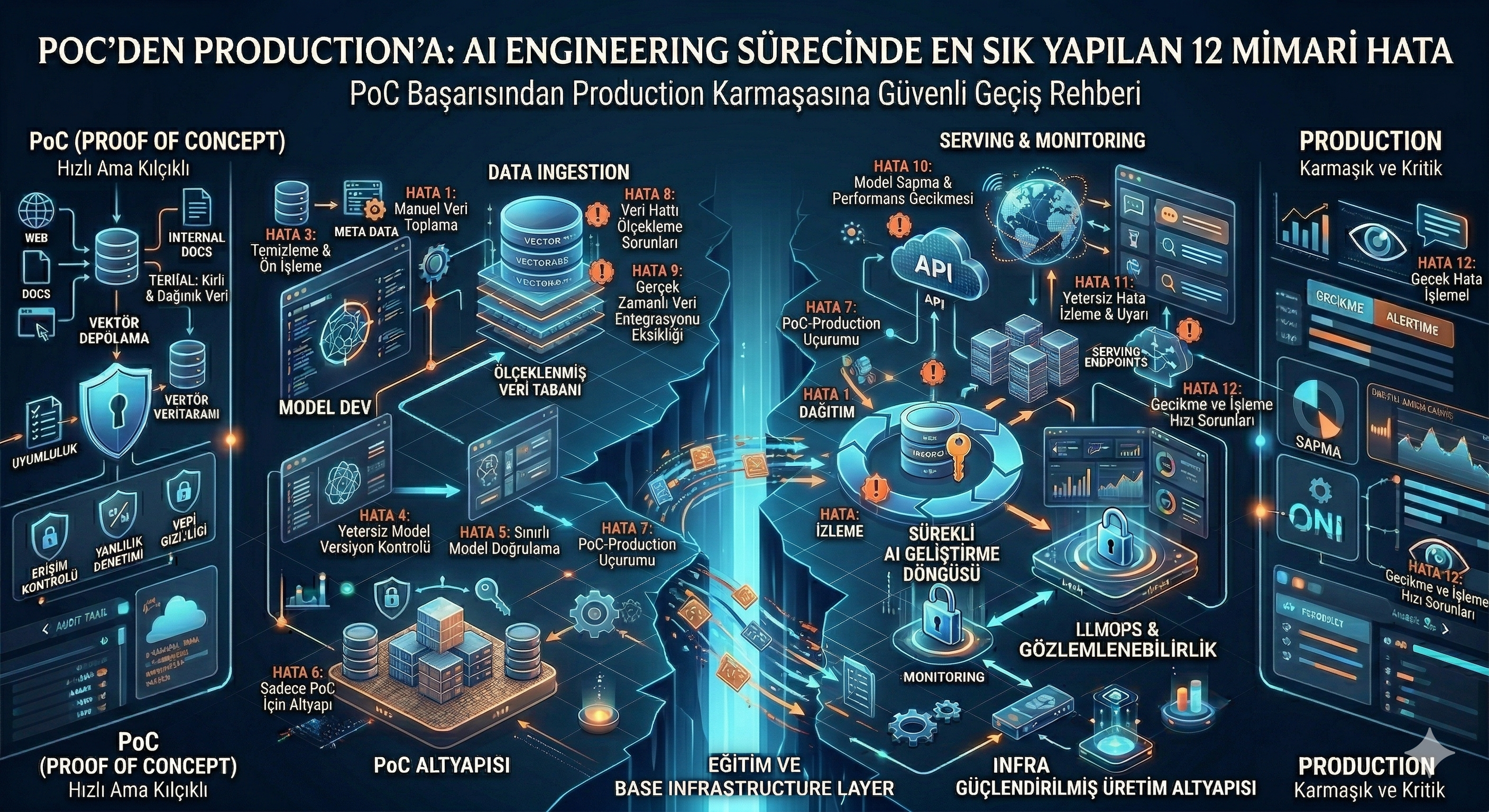
From PoC to Production: The 12 Most Common Architectural Mistakes in AI Engineering

Many AI projects start with an impressive proof of concept but fail when they move toward production. In most cases, the root cause is not model quality alone, but weak architectural decisions, missing operational discipline, and a lack of production-grade AI engineering practices. This guide explains the 12 most common architecture mistakes teams make on the journey from PoC to production, and shows how to build more reliable, scalable, and maintainable AI systems.

20 minLLMOps
Guide

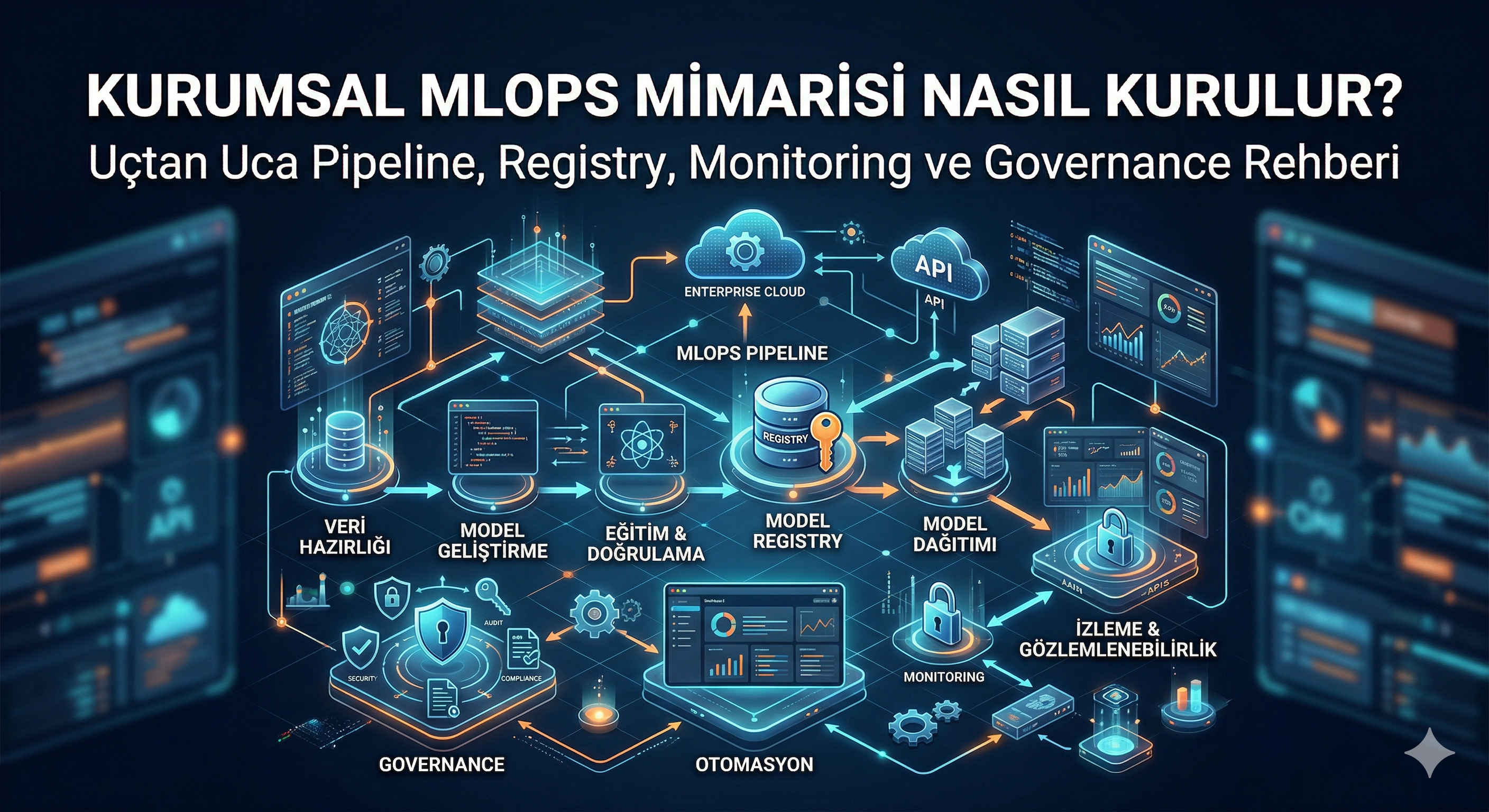
How to Build an Enterprise MLOps Architecture: An End-to-End Guide to Pipelines, Registry, Monitoring, and Governance

Enterprise MLOps is not just about deploying models. Real impact comes from building an end-to-end operating system that covers data pipelines, experiment tracking, model registry, deployment, monitoring, governance, and continuous improvement. This guide explains how to design a production-grade MLOps architecture, which layers matter most, how teams should operate, and what to prioritize for scalable, secure, and measurable AI delivery.

18 minLLMOps