From PoC to Production: The 12 Most Common Architectural Mistakes in AI Engineering
Many AI projects start with an impressive proof of concept but fail when they move toward production. In most cases, the root cause is not model quality alone, but weak architectural decisions, missing operational discipline, and a lack of production-grade AI engineering practices. This guide explains the 12 most common architecture mistakes teams make on the journey from PoC to production, and shows how to build more reliable, scalable, and maintainable AI systems.
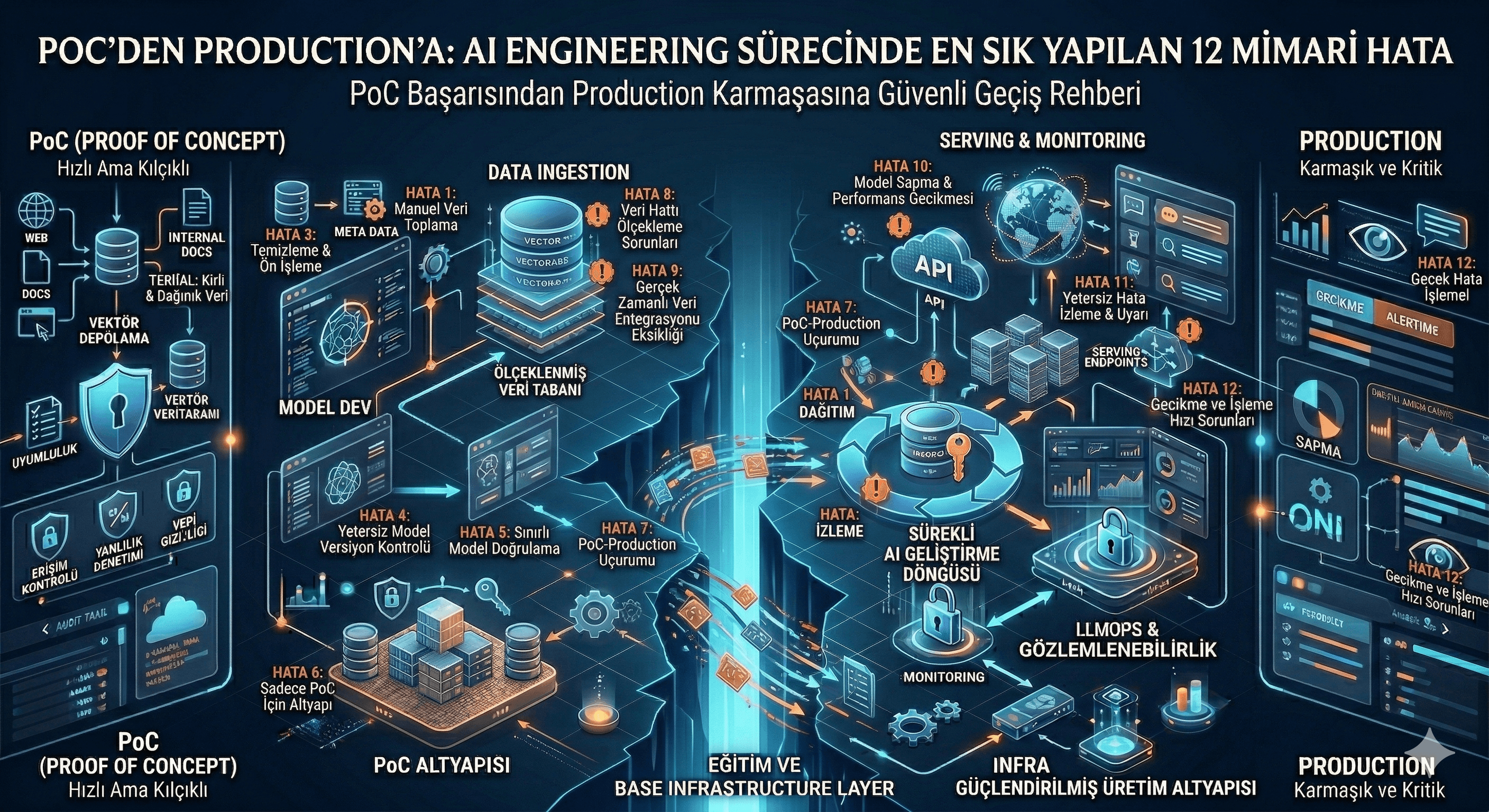
Many AI projects look highly promising during the proof-of-concept phase. A strong demo, a few carefully selected outputs, and a compelling presentation can create significant momentum. But the real challenge usually begins after that. The reason is simple: an impressive PoC and a sustainable production system are not the same thing.
In most cases, production failure is not caused by the model alone. The real issue is that the architecture was designed to “work once,” not to be operated reliably over time. Data flows stay fragile, services grow inconsistently, observability is missing, security is treated too late, costs rise without control, and teams gradually lose the ability to reason about the system as it grows.
In this guide, we will examine the 12 most common architecture mistakes teams make when moving from PoC to production in AI engineering. The goal is not only to list the mistakes, but also to explain why they happen, how they surface in real systems, and how to prevent them.
What Is the Real Difference Between a PoC and Production?
A proof of concept is designed to validate whether an idea can work. Speed is usually the top priority. Code quality, observability, rollback strategies, governance, scale, and operational resilience are often secondary.
A production system, however, must answer very different questions:
- Does the system behave consistently?
- Can it handle real-world data variability?
- Will performance remain acceptable under load?
- Can teams trace what version is running and why?
- Can the system be rolled back safely?
- Are risk, security, and compliance requirements being managed?
- Will this still be maintainable in six months?
In short, a PoC answers “Is this possible?” Production must answer “Is this reliable, scalable, secure, and operable?”
"Critical reality: Being technically functional is not the same as being production-ready.
1. Treating PoC Code as Production Code
This is one of the most common mistakes. Teams often keep expanding the original prototype until it quietly becomes the production system. That may seem efficient at first, but it usually leads to fragile, hard-to-maintain architectures.
Typical PoC code problems include:
- business logic packed into one place
- hardcoded configuration
- little or no testing
- weak error handling
- minimal logging and observability
- poor modularity
The right production approach is not to worship the prototype, but to preserve the learnings and rebuild the system on a stronger engineering foundation.
2. Failing to Design the Data Layer for Production
In AI systems, data often determines the fate of the system more than the model itself. PoCs tend to use curated or simplified datasets, while production introduces delays, missing values, schema changes, distribution shifts, and unexpected edge cases.
When the data layer is not designed properly, teams face:
- training-serving inconsistency
- silent format failures
- quality degradation due to incomplete inputs
- irreproducible behavior
- leakage and temporal validation issues
3. Making the Model the Center Instead of the Product
Many teams build AI projects around the model, but users experience the product, not the model. Real-world adoption depends on latency, clarity, trust, fallback behavior, workflow fit, and user experience—not just model accuracy.
4. Building Everything as One Giant Service
A single service may be acceptable during experimentation, but in production, mixing ingestion, inference, retrieval, orchestration, evaluation, and monitoring logic into one codebase creates long-term maintenance and scaling problems.
5. Leaving Evaluation Until the End
One of the biggest mistakes in AI engineering is trying to “measure quality later.” If evaluation is not designed early, teams end up with vague quality expectations, weak regression control, and fragile release decisions.
6. Going Live Without Observability
A system may appear healthy from the outside while quietly degrading on the inside. Without visibility into data health, model behavior, latency, cost, and user-level failure patterns, teams operate blindly.
7. Treating Security as a Late-Stage Add-On
AI systems, especially generative systems, introduce unique security risks such as prompt injection, data leakage, unsafe tool use, and excessive access exposure. Security must be embedded into the architecture from the beginning.
8. Operating Without Governance or Clear Ownership
Once an AI system reaches production, someone must own the model, the release decisions, the quality thresholds, and the rollback process. Without governance, systems become difficult to control, audit, or defend.
9. Delaying Scale, Latency, and Throughput Thinking
A system that works for a few internal users may collapse under real-world concurrency. Performance, token cost, retrieval latency, and queue behavior must be considered before—not after—production rollout.
10. Ignoring Cost Architecture
Technical success does not guarantee economic sustainability. Inference cost, data processing, retraining, evaluation, and observability all add up. Teams that ignore cost architecture often discover too late that scaling the system is not financially viable.
11. Failing to Define Human Review Boundaries
Not every AI-driven action should be fully automated. In high-risk workflows, the real goal is not maximum autonomy, but the right level of control. Human-in-the-loop design is often what makes an AI system usable in enterprise environments.
12. Designing Around Tools Instead of Operating Principles
One of the most strategic mistakes is to let tool selection drive the architecture. Teams sometimes choose platforms first and only later realize they have not defined ownership, quality gates, workflows, or system principles clearly enough.
The Shared Root Cause Behind These 12 Mistakes
Although these mistakes appear in different layers, they usually stem from the same core issue: the system was designed for demo success instead of production reality. It was treated as a technical experiment rather than an operational product.
How to Prevent These Mistakes
- Design a deliberate transition between PoC and production
- Architect the system in layers
- Define success metrics early
- Build observability from the start
- Use risk-based controls
- Balance quality, performance, and cost together
A Reference Checklist for Production-Grade AI Engineering
- Are data sources clearly defined?
- Are data quality gates in place?
- Is model and prompt versioning implemented?
- Are evaluation and regression tests defined?
- Is there a staging environment?
- Is there a rollback strategy?
- Are latency and cost visible?
- Are observability dashboards active?
- Are access and security controls enforced?
- Is governance and ownership documented?
- Are human review points defined?
- Are business and technical metrics connected?
A 30-60-90 Day Improvement Plan
First 30 Days
- Map the current system architecture
- Identify technical debt and fragility points
- Surface data, evaluation, and observability gaps
- Classify high-risk workflows
- Clarify ownership and accountability
Days 31-60
- Implement evaluation and regression structures
- Launch observability and cost dashboards
- Separate services and processing flows logically
- Standardize model or prompt versioning
- Introduce access and security controls
Days 61-90
- Formalize release and rollback management
- Build human-in-the-loop into sensitive workflows
- Establish governance and audit processes
- Optimize latency and cost behavior
- Turn the first stable system into a reference architecture
Final Thoughts
Moving from PoC to production in AI engineering is not just about exposing a model to more users. It is about maturing the entire system technically, operationally, and organizationally. Most failures are not caused by the wrong model, but by the wrong architectural assumptions.
The 12 mistakes in this article represent the most common failure points teams face on the way to production. The central lesson is clear: production-grade AI is not built from systems that merely run, but from systems that are controlled, observable, secure, and sustainable.
The teams that create lasting value are the ones that treat AI not as a one-time experiment, but as a living product and an operating capability.
Consulting Pathways
Consulting pages closest to this article
For the most logical next step after this article, you can review the most relevant solution, role, and industry landing pages here.
AI Governance, Risk and Security Consulting
A governance framework that makes enterprise AI usage more sustainable across data, access, model behavior and operational risk.
AI Evaluation, Guardrails and Observability
A comprehensive evaluation layer to measure, observe and control AI accuracy, safety and performance.
Enterprise AI Architecture Consulting for CTOs
Technical leadership consulting to move AI initiatives from isolated PoCs into secure, scalable and production-ready architecture.