How to Build an Enterprise MLOps Architecture: An End-to-End Guide to Pipelines, Registry, Monitoring, and Governance
Enterprise MLOps is not just about deploying models. Real impact comes from building an end-to-end operating system that covers data pipelines, experiment tracking, model registry, deployment, monitoring, governance, and continuous improvement. This guide explains how to design a production-grade MLOps architecture, which layers matter most, how teams should operate, and what to prioritize for scalable, secure, and measurable AI delivery.
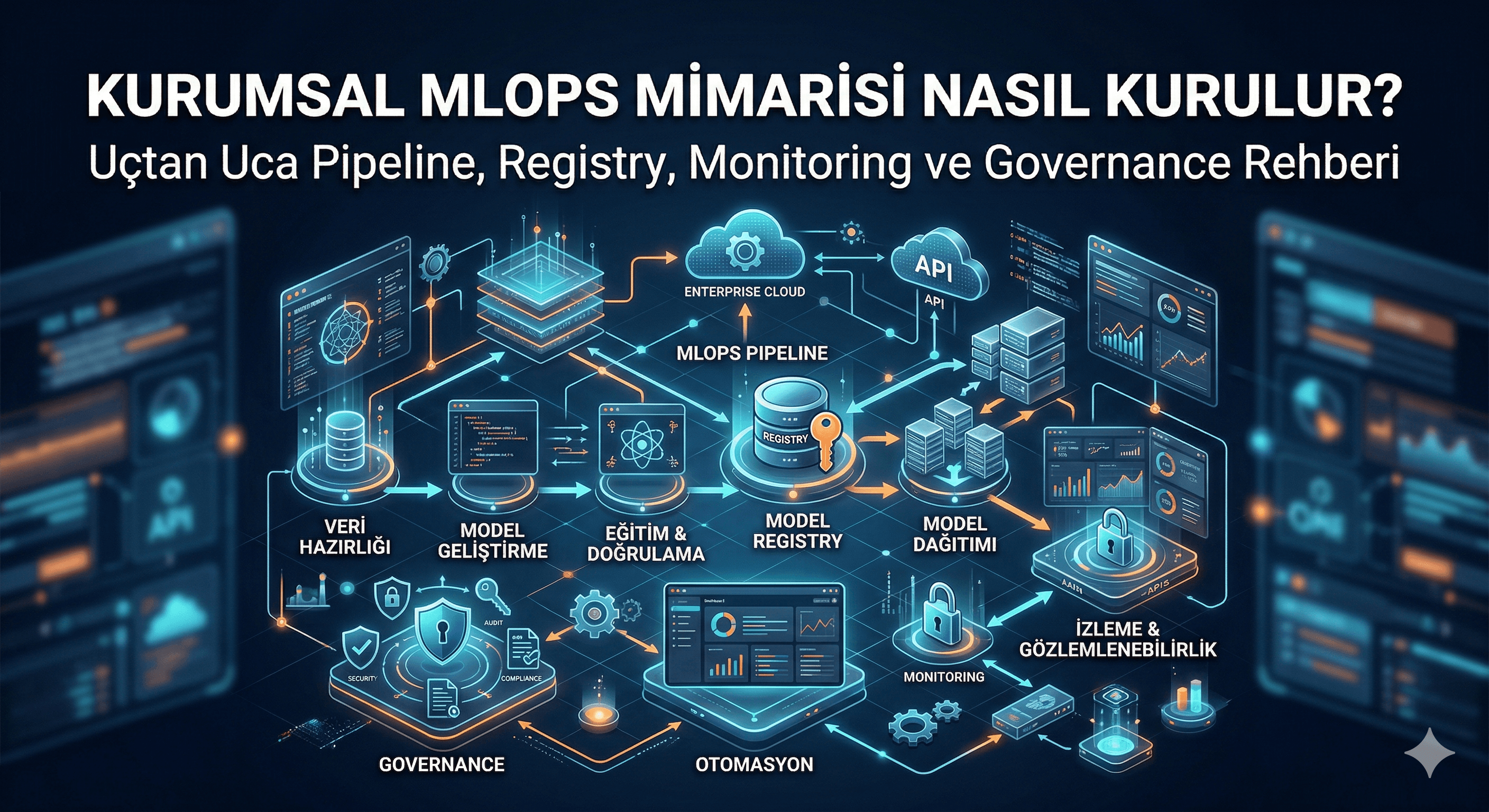
Many machine learning initiatives look promising in experimentation but struggle once they reach production. In most cases, the problem is not the model alone. The real issue is the lack of a reliable operating system around the model: unstable data flows, untracked experiments, unmanaged model versions, manual deployment, weak monitoring, and missing governance.
This is where MLOps becomes essential. In enterprise settings, MLOps is not simply about deploying a model. It is the discipline of designing, operating, monitoring, and continuously improving machine learning systems in a secure, scalable, and measurable way.
In this guide, we will walk through the core layers of an enterprise MLOps architecture, explain how an end-to-end workflow should operate, and outline the principles required to build production-grade AI systems that can actually survive beyond proof-of-concept.
What Is Enterprise MLOps?
MLOps is the combination of engineering, operational, and governance practices needed to build, deploy, monitor, and improve machine learning systems. At enterprise scale, however, the definition becomes broader. It includes not only technical performance, but also reproducibility, traceability, access control, lifecycle management, auditability, and alignment with business outcomes.
A mature enterprise MLOps architecture should be able to answer the following questions clearly:
- Where does the data come from, and how is it validated?
- Which dataset, parameters, and environment were used to train a model?
- Which model version is currently in production, and why?
- How is production quality monitored over time?
- How do teams detect data drift or concept drift?
- Who owns the model technically and from a business perspective?
- Can the model be rolled back safely when needed?
- How are security, compliance, and governance requirements enforced?
Why Enterprise MLOps Matters
Machine learning is no longer limited to experimentation teams. It now shapes forecasting, recommendation, fraud detection, customer support, search, internal copilots, and decision support across multiple business functions. As adoption expands, the cost of operational failure increases.
A model can be technically impressive and still be operationally weak. Without version control, monitoring, quality gates, and governance, even strong models become fragile assets. That is why enterprise AI maturity increasingly depends on how models are operated, not only on how they are trained.
"Key idea: In enterprise AI, success does not come from a “good model” alone. It comes from a well-operated system around the model.
The Core Layers of an Enterprise MLOps Architecture
1. Data Layer
The data layer is the foundation of every MLOps system. It defines source systems, data ownership, quality checks, schema control, validation logic, lineage, and consistency between training and inference environments.
2. Feature and Transformation Layer
Raw data is rarely ready for training. This layer covers feature engineering, transformations, aggregation logic, time-aware calculations, and the consistency of feature computation across offline and online settings.
3. Experimentation and Training Layer
Experiments must be tracked systematically. A production-grade setup should record datasets, parameters, metrics, training context, and evaluation outputs in a repeatable structure rather than relying on scattered notebooks or informal documentation.
4. Pipeline Orchestration Layer
Pipelines coordinate data preparation, model training, evaluation, packaging, and deployment. The goal is not just automation, but reliable orchestration with retries, dependencies, modular steps, and operational transparency.
5. Model Registry Layer
A model registry is not just a place to store artifacts. It is the formal control point of the model lifecycle. It should manage versions, states, evaluation records, training context, approval status, and lifecycle transitions such as development, staging, production, and archive.
6. Deployment and Serving Layer
This layer defines how models are exposed to production systems. Key decisions include batch versus real-time inference, rollout strategy, rollback readiness, scalability expectations, and operational service quality.
7. Monitoring and Observability Layer
Monitoring should go beyond infrastructure. Strong MLOps includes operational metrics, data drift detection, output behavior, business KPIs, model quality tracking, and failure pattern analysis.
8. Governance, Security, and Compliance Layer
This is where enterprise AI becomes truly operational. Governance defines ownership, approval workflows, access rights, auditability, model risk classification, documentation standards, and rollback procedures.
What an End-to-End MLOps Flow Looks Like
- Data is collected from source systems.
- Quality and schema checks are applied.
- Features and transformations are generated.
- Training pipelines are executed.
- Experiment results are tracked and evaluated.
- Qualified model candidates are promoted to the registry.
- Staging validation and integration tests are completed.
- Approved versions are deployed to production in a controlled way.
- Operational, data, and business metrics are continuously monitored.
- Retraining, rollback, or investigation workflows are triggered when needed.
Design Principles for Enterprise MLOps
- Reproducibility: The same inputs should lead to the same outputs under the same conditions.
- Modularity: Pipelines should be decomposed into manageable, reusable steps.
- Observability: Teams must be able to see system health, data health, and model behavior clearly.
- Controlled automation: Not every step should be fully automated, especially in high-risk workflows.
- Security and access boundaries: Data, models, and services must follow role-based access logic.
- Business alignment: Model quality must be linked to measurable business outcomes.
Why Model Registry Is Strategically Important
In mature organizations, the model registry becomes the institutional memory of machine learning operations. It explains what was trained, how it was evaluated, who approved it, what stage it is in, and how it can be rolled back. Without a registry, teams often rely on personal memory and fragmented documentation, which creates operational and compliance risk.
What Teams Often Miss in Monitoring
- Data drift: Production inputs move away from the training distribution.
- Concept drift: The relationship between inputs and outcomes changes over time.
- Segment-level degradation: Overall metrics may look stable while specific segments deteriorate.
- Latency issues: A correct model can still fail operationally if it becomes too slow.
- Feedback delays: True labels may arrive too late to surface quality issues quickly.
Why Governance Cannot Be an Afterthought
Governance is what turns machine learning into a manageable enterprise capability. It defines model ownership, approval paths, risk levels, documentation requirements, rollback conditions, and audit evidence. In regulated and large-scale environments, governance is not optional. It is part of the architecture.
Recommended Team Structure
| Role | Primary Responsibility |
|---|---|
| Data Scientist | Model development, experimentation, and evaluation |
| ML Engineer | Pipelines, packaging, deployment, and integration |
| Data Engineer | Data flows, quality, transformation, and access patterns |
| Platform / DevOps Engineer | Infrastructure, CI/CD, scaling, and observability |
| Business / Domain Owner | Use-case ownership, KPI definition, and impact validation |
| Security / Compliance / Risk | Governance, controls, compliance, and audit readiness |
Common Architecture Mistakes
- Treating notebook code as production-ready software
- Managing model versions without a registry
- Monitoring only infrastructure but not model behavior
- Using offline metrics as the only success criterion
- Adding governance too late in the process
- Building one giant pipeline instead of modular workflows
- Ignoring data contracts and quality gates
30-60-90 Day Enterprise MLOps Plan
First 30 Days
- Map current models, datasets, and production workflows
- Identify the most critical operational gaps
- Define ownership and accountability
- Select one or two high-impact pilot use cases
Days 31-60
- Introduce experiment tracking and model versioning standards
- Set up the first registry workflow
- Establish quality gates and staging validation
- Build the first monitoring dashboard
Days 61-90
- Operationalize modular training and deployment pipelines
- Define rollback and incident procedures
- Formalize governance and documentation standards
- Connect technical and business metrics into one operating view
Final Thoughts
Enterprise MLOps is not a toolset. It is an operating model. Organizations that understand this build machine learning systems that are not only accurate, but also reliable, auditable, secure, and sustainable. In practice, long-term AI value is created not by the model alone, but by the discipline surrounding the model lifecycle.
The most important question, therefore, is not simply “Which model should we use?” but rather “How do we operate this system in a controlled, scalable, and business-aligned way?” That is the real foundation of production-grade AI.
Consulting Pathways
Consulting pages closest to this article
For the most logical next step after this article, you can review the most relevant solution, role, and industry landing pages here.
AI Governance, Risk and Security Consulting
A governance framework that makes enterprise AI usage more sustainable across data, access, model behavior and operational risk.
AI Evaluation, Guardrails and Observability
A comprehensive evaluation layer to measure, observe and control AI accuracy, safety and performance.
Enterprise AI Architecture Consulting for CTOs
Technical leadership consulting to move AI initiatives from isolated PoCs into secure, scalable and production-ready architecture.