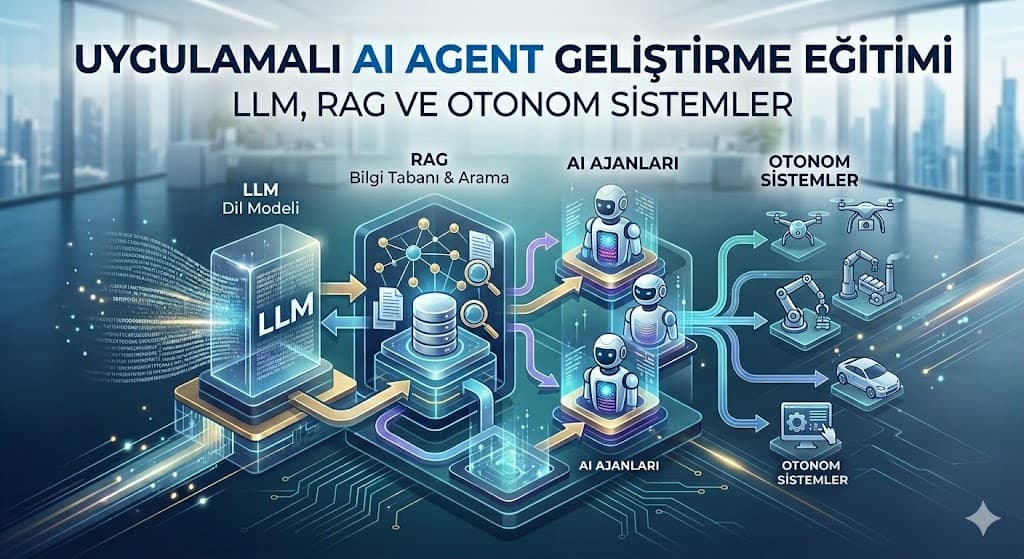
Applied AI Agent Development Training: LLM, RAG, and Autonomous Systems
Learn to design and deploy autonomous AI agents capable of planning and executing tasks without human intervention using LLMs, tool calling, and long-term memory architectures.
About This Course
Training Methodology
End-to-end lifecycle (Design -> Dev -> CI/CD -> Monitor)
Real-world scenarios and workflow automation
"Tool-augmented" approach for cost optimization
Security and Regulation (GDPR) focused architecture
Who Is This For?
Why This Course?
To reduce human error by increasing operational efficiency.
To minimize hallucination rates with RAG integration.
To dynamically adapt to increased load with scalable automation.
To gain competitive advantage by rapidly deploying autonomous features.
Learning Outcomes
Requirements
Course Curriculum
- Welcome and Course Objectives
- Program structure, modules, timeline
- Participant profiles and prerequisites
- Success indicators, evaluation criteria
- AI Agent Definition, Motivation, and History
- Rule-based → data-driven → LLM-backed evolution
- AutoGPT, BabyAGI, CrewAI, OpenAI Function Calling timeline
- "Tool use = the new fine-tuning" paradigm
- Agent Ecosystem and Core Components
- Planner, executor, critic layers
- Memory classes: short-term, long-term, episodic, semantic
- Toolbox, action-observation loop
- Orchestration patterns: single/multi-agent, synchronous/asynchronous
Instructor
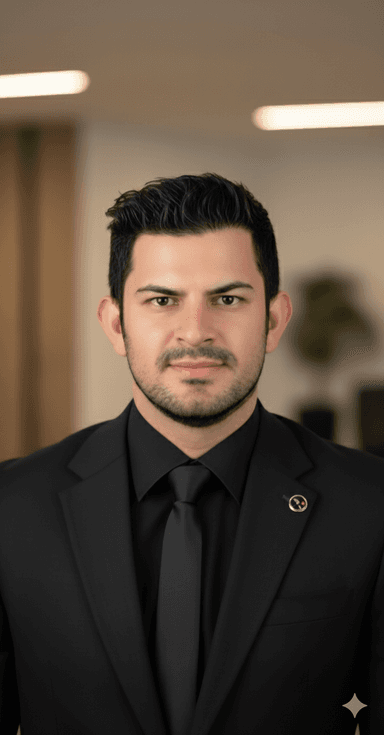
Şükrü Yusuf Kaya
AI Consultant & Instructor
Şükrü Yusuf KAYA is an internationally experienced AI Consultant and Technology Strategist leading the integration of artificial intelligence technologies into the global business landscape. With operations spanning 6 different countries, he bridges the gap between the theoretical boundaries of technology and practical business needs, overseeing end-to-end AI projects in data-critical sectors such as banking, e-commerce, retail, and logistics. Deepening his technical expertise particularly in Generative AI and Large Language Models (LLMs), KAYA ensures that organizations build architectures that shape the future rather than relying on short-term solutions. His visionary approach to transforming complex algorithms and advanced systems into tangible business value aligned with corporate growth targets has positioned him as a sought-after solution partner in the industry. Distinguished by his role as an instructor alongside his consulting and project management career, Şükrü Yusuf KAYA is driven by the motto of "Making AI accessible and applicable for everyone." Through comprehensive training programs designed for a wide spectrum of professionals—from technical teams to C-level executives—he prioritizes increasing organizational AI literacy and establishing a sustainable culture of technological transformation.
Frequently Asked Questions
Apply for Training
Boutique training with limited seats.
Pre-register for Next Groups
Leave your info to be the first to know when the next batch opens.
1-on-1 Mentorship
Book a private session.